
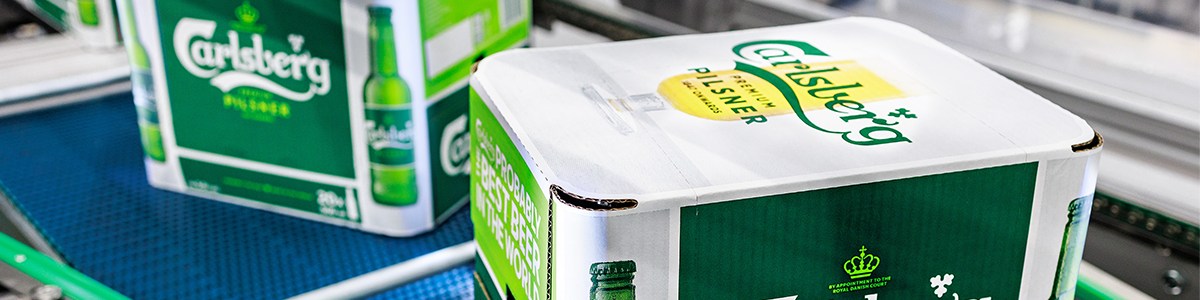
Carlsberg’s innovative rounded-corner multipacks, developed with DS Smith and KHS, enhance shelf visibility while reducing carbon emissions sustainably.
When Carlsberg starts contemplating innovative new packaging designs, the focus is on the consumer. Packaging innovation director Marine Andre gets straight to the point. “For us, consumer experience has top priority. After all, in store we have less than two seconds for our products to be noticed on the shelf. If you’re not conspicuous, you’re not there.” This is hardly surprising when we consider that one consumer passes about 300 different products a minute at the supermarket. Intensive market research has discovered that sustainability is something consumers expect – but don’t actively ‘reward’. They’re not willing to pay a premium for it. It’s thus all the more important that sustainable packaging is both functional and gets brands noticed. “We’re consciously trying to break down the barriers between sustainable packaging, optimized costs and the perfect consumer experience,” explains Andre. “If a system doesn’t score with at least two of these criteria, it’s doomed to fail.”
Visual brand presence
One good example that shows how Carlsberg is exploring new avenues is the DS Smith Round Wrap®, a cardboard multipack with curved edges for beer bottles. It provides added value on three counts. Firstly, it gives the brand a greater visual presence, upgrades the pack and boosts its impact on the shelf. This has been proved by scientific studies carried out by the Harvard Medical School, among others: they show that objects with round shapes are perceived as being more attractive than those with square corners and edges. Secondly, this new style of secondary packaging uses less material, has a smaller carbon footprint and is better protected against damage during transportation. And thirdly, as the pack can be produced on existing packaging machines, no large investments are needed, with the consumer not having to pay a higher price.
Long learning process
Before the new multipack made it onto the shelf, however, the concept had to undergo a lengthy learning process. “We started the first trials in Sweden back in 2020,” remembers senior packaging implementation and optimization manager Bogdan Volkotrub, the man who holds operative responsibility for the project at Carlsberg headquarters. “Before we started thinking in greater quantities, we first wanted to prove on a small scale that this solution could actually be implemented at all. At first, we weren’t successful because we couldn’t produce constant quality.” The breakthrough ultimately came with participation of the right partners in 2022. DS Smith, manufacturer of sustainable packaging, was able to provide sufficient material and exhibited the necessary testing, learning and validation perseverance, working in a team with Dortmund systems supplier KHS. The latter first analyzed which of its packaging machines in operation in the Carlsberg universe could process the new packs without the need for substantial conversion. “It’s like playing with LEGO,” is how Volkotrub describes the process. “One piece is the material, one represents the machine and a third stands for teamwork. If just one bit doesn’t fit, you can’t build anything decent from the pieces.”
Finding the right market
All that then remained to be done in order to make that perfect fit and finally go live was to identify a suitable test market. The choice eventually fell to the sales region serviced by Carlsberg’s Polish subsidiary. Here, bottled brand products such as Carlsberg, Garage and Somersby are primarily packaged into big packs holding 20 or 24 containers. For these, wrap-around cartons are used instead of plastic crates. The production site also already had a packer that could produce the new multipack, namely a KHS Innopack Kisters WP Advanced. In 2024 the first packs with rounded corners began to appear on the shelves of Polish supermarkets.